
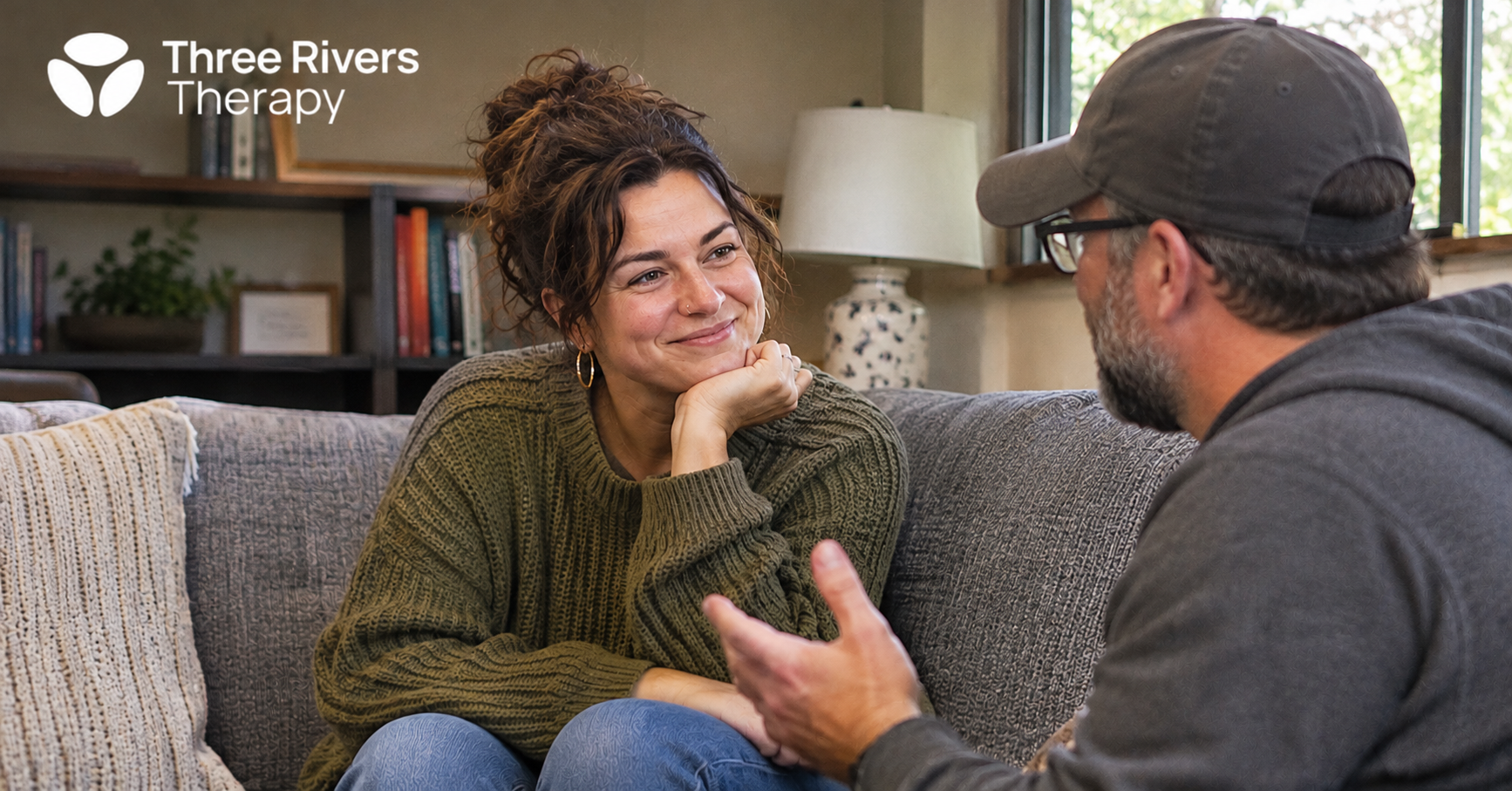
A Different Kind of Support
Sometimes, what a person needs most during a difficult period is a place to talk with someone who understands what it can feel like to navigate mental-health challenges.
Peer support inside a peer respite setting offers that kind of connection. It is support provided by people who draw on their own lived experience of mental-health challenges and recovery, alongside training, to listen, share perspectives, and help others consider what might work for them.[1][2]
Rather than requiring a guest to follow a single path, peer support centers the person’s own goals, preferences, and sense of what recovery means.
What Makes Peer Support Different?
A peer worker’s lived experience is an important part of the relationship. They may recognize the uncertainty, frustration, or isolation that can accompany a difficult time without assuming that everyone’s experience is the same.
Peer support is not about a worker telling someone exactly what to do. It can mean listening without judgment, asking thoughtful questions, sharing an experience when it is relevant, and helping a guest recognize strengths they may have overlooked.[2]
The relationship should be collaborative. Guests can describe what feels useful, what does not, and what they would like to work toward.
What Does Peer Respite Look Like?
Washington’s Health Care Authority describes peer respites as voluntary, short-term, overnight settings that are home-like and centered on peer support.[1] The atmosphere and daily activities can differ from one program to another.
A guest might spend time talking with a peer worker, resting, reflecting on what has been stressful, or considering the people and routines they want to reconnect with afterward.
An important part of the experience is having room to make choices. A person may want conversation one day and quiet time another. Asking what participation looks like at a specific program can help set expectations.
What Might a Peer Conversation Include?
A conversation might begin with a simple question: ‘What has been hardest lately?’ From there, the guest may choose to discuss relationships, stress, sleep, a recent setback, or what has helped during earlier difficult periods.
Peer workers can help guests explore coping ideas, community connections, and possible next steps. They may share their own perspective when it helps the guest feel less alone, while recognizing that the guest is the expert on their own life.[2]
Not every conversation needs to end with a solution. Feeling heard and having space to reflect can be meaningful in itself.
What Peer Respite Is Not
Peer respite is not the same as inpatient psychiatric treatment or emergency medical care. Washington’s peer respite model is nonmedical; it is not a setting for prescribing medication or providing hospital-level services.[1]
Someone who needs urgent medical attention or immediate protection from harm may need a different level of support. In a life-threatening emergency, call 911. For emotional distress or a mental-health crisis, call or text 988.
Understanding these differences helps people decide whether peer respite belongs among their available support options.
Questions Worth Asking Before a Stay
Before requesting a stay, ask how self-referral works, who is eligible, how long guests may stay, whether the location has openings, and what accommodations are available.
It may also help to ask what peer workers do during a typical day, how guests can express preferences, what to bring, and how the program responds if someone needs additional care.
These questions are not a test of whether someone is ‘ready’ for help. They are a way to make an informed choice.
Finding Peer Support in Kennewick
Washington’s Health Care Authority identifies Three Rivers Therapy as a peer respite provider in Kennewick.[1] Anyone interested in this option can contact Three Rivers Therapy to learn about its current services and how to request information about a stay.
Peer support is grounded in a straightforward idea: people who have navigated difficult experiences can offer meaningful connection to others. In a peer respite setting, that connection can create space to reflect, regain perspective, and consider what comes next.
How Lived Experience Shapes the Conversation
Peer support is grounded in the idea that people can learn from others who have faced challenges of their own. A peer worker does not need to have experienced the same diagnosis, event, or circumstances to offer useful understanding. Instead, they can recognize the importance of being heard, making decisions, and rebuilding a sense of possibility.
This distinction matters because two people can describe similar symptoms and still need very different kinds of support. One guest may want to talk about a difficult relationship. Another may be looking for ways to reconnect with community or manage the demands of daily life. A peer worker can respond with curiosity rather than assuming there is one correct answer.
Sharing lived experience should serve the guest, not shift attention away from them. A peer might say that something helped in their own recovery while acknowledging that it may not be right for everyone.
Choice and Personal Boundaries Matter
A peer respite stay is voluntary, and that principle should be reflected in everyday interactions. A guest may have preferences about conversation, personal space, routines, or how they describe their experiences. Respecting those preferences helps make support collaborative rather than directive.
It can be useful to ask about privacy and confidentiality before a stay. Guests should understand how the program handles personal information, what staff may document, and what exceptions to confidentiality may apply. Specific policies should be discussed directly with the program rather than assumed.
Choice does not mean that a setting has no expectations. Programs may have house guidelines, eligibility requirements, and safety procedures. Asking about them ahead of time helps people decide whether the setting is appropriate.
Small Moments Can Be Meaningful
Support does not always look like a formal meeting. It might be a conversation while preparing a meal, an invitation to sit together in a common room, or an opportunity to talk after a difficult phone call. Ordinary interactions can help reduce the feeling that every discussion must revolve around a crisis.
For someone who has felt isolated, being treated as a whole person can be important. Their interests, humor, hopes, and relationships still matter even when they are having a hard time. Peer support can create space for those parts of life alongside conversations about distress.
How to Decide Whether It Is Worth Exploring
Someone considering peer respite can begin by identifying what they hope would be different after a short stay. Perhaps they want a pause from a stressful environment, an opportunity to speak openly, or time to think about next steps. These goals can guide questions to program staff.
It is also reasonable to ask whether a different service would be a better fit. If someone needs medical monitoring, inpatient treatment, or immediate emergency care, a nonmedical respite setting may not meet those needs. A healthcare professional or crisis service can help assess urgent concerns.
Sources
- Washington State Health Care Authority. Peer respites.
https://www.hca.wa.gov/about-hca/programs-and-initiatives/behavioral-health-and-recovery/peer-respites
- SAMHSA. Peer Support Workers.
https://www.samhsa.gov/substance-use/recovery/peer-support-workers