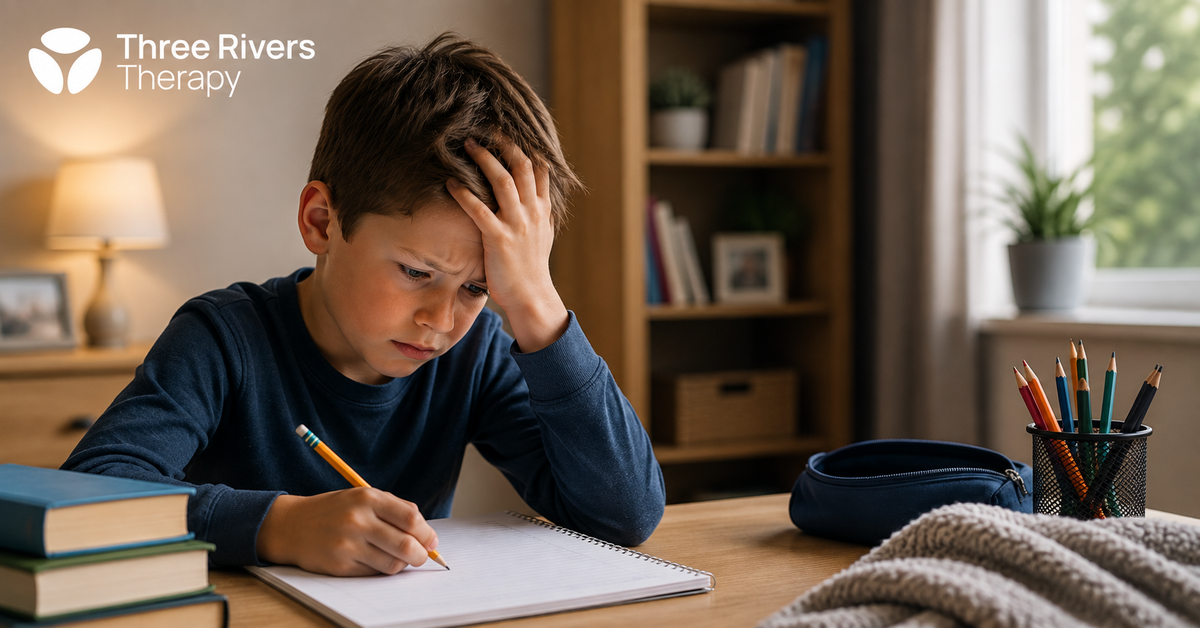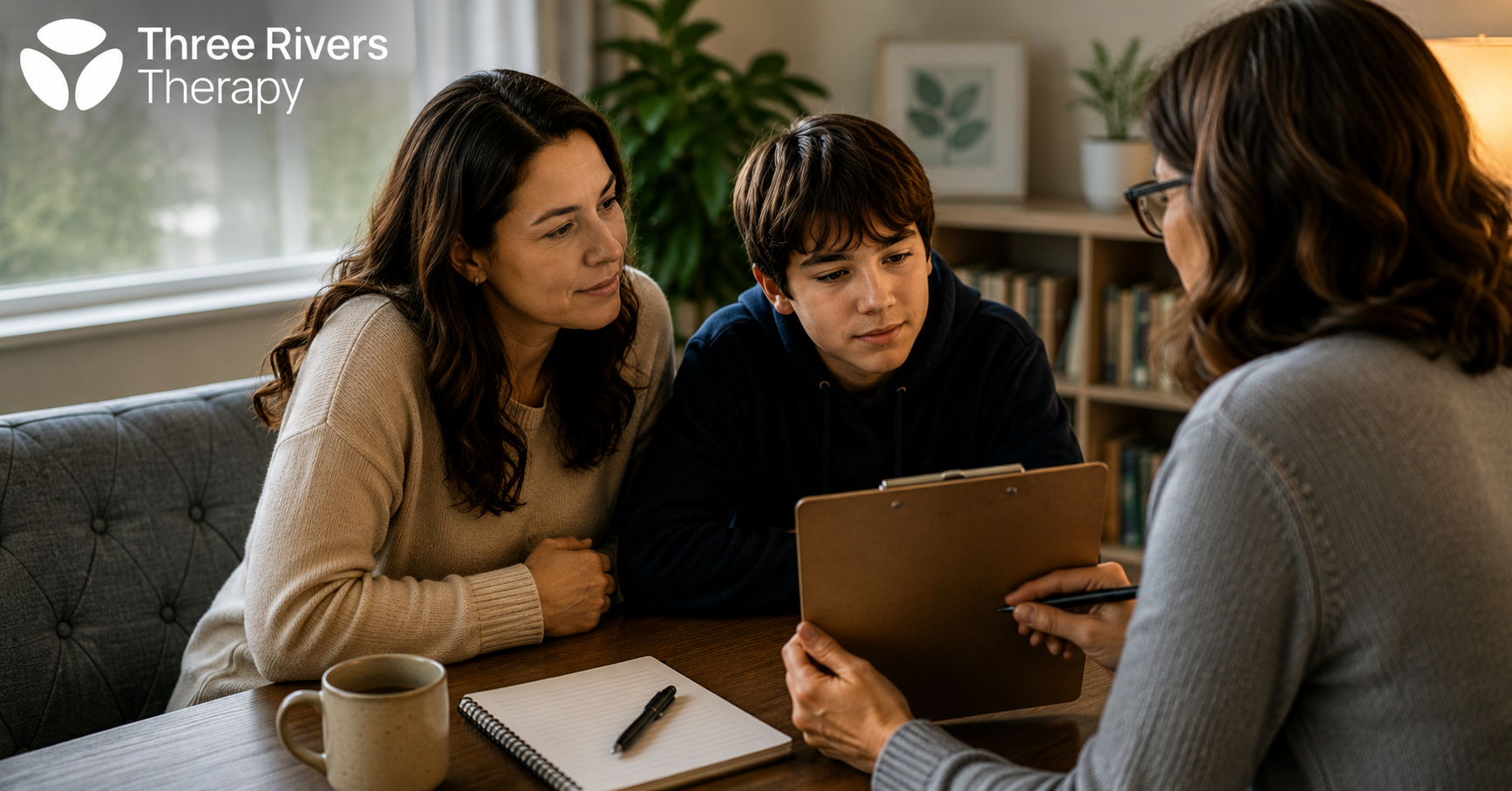

If you’re lying awake at night worried about your child’s constant worries, you are not overreacting. If you’ve noticed your once-confident child refusing to go to school, avoiding their friends, or complaining of stomachaches with no medical cause, your instinct that something is wrong is correct. Parents often come to my clinic apologizing for “making a big deal” out of anxiety, only to learn that their child has been struggling silently for months or years. I want to be clear: what you’re noticing matters. Childhood anxiety is real, it is treatable, and getting help early changes everything.
All Children Worry. So What’s an Anxiety Disorder?
Normal worry is part of childhood development. Children worry about tests, fitting in, their appearance, whether they’ll make the soccer team. That’s healthy and age-appropriate. But there’s a crucial difference between normal worry and an anxiety disorder.
According to the Anxiety & Depression Association of America (ADAA), anxiety disorders are the most common mental health condition in children, affecting 1 in 8 kids. The distinction is not whether a child worries but whether the worry persists, intensifies, and interferes with their life.
The DSM-5 diagnostic criteria for Generalized Anxiety Disorder in children require that symptoms persist for at least six months and cause significant distress or impairment in functioning, whether at school, with friends, or at home. Normal worry is proportionate to the situation and temporary. Clinical anxiety is persistent, disproportionate, and doesn’t resolve with reassurance.
How Childhood Anxiety Actually Shows Up
This is where parents often get stuck. We think anxiety means a worried child, constantly talking about their fears. But anxiety in children rarely looks like that. Instead, it shows up as avoidance, physical complaints, perfectionism, and frustration that parents misinterpret as defiance or drama.
School Refusal & Avoidance. Your child refuses to attend school, go to soccer practice, attend birthday parties, or participate in activities they once loved. They develop elaborate excuses or have panic responses to the prospect of these situations.
Physical Complaints Without Medical Cause. Frequent stomachaches, headaches, muscle tension, or nausea that have no medical explanation. Your pediatrician has ruled out infections or physical illness, yet the complaints persist.
Perfectionism & Fear of Failure. Your child becomes paralyzed by fear of making mistakes. They refuse to try new activities because they might not be perfect immediately. They have rigid thinking about grades, appearance, or performance.
Reassurance-Seeking Loops. Your child asks the same “what if” question repeatedly: “What if I get sick?” “What if you get in an accident?” “What if nobody likes me?” You provide reassurance, they feel better briefly, then ask again within hours or minutes.
Irritability & Meltdowns. Especially in younger children, anxiety often emerges as irritability rather than obvious worry. Your child has extreme reactions to minor frustrations, transitions, or perceived criticism. What looks like defiance is actually anxiety hijacking their nervous system.
Sleep Refusal & Nightmares. Your child fights bedtime, has frequent nightmares, or wakes in the night with panic. Sleep becomes another arena where anxiety takes control.
Consider an 8-year-old I worked with last year. Every Sunday night she would cry uncontrollably, complaining of stomachaches. She began refusing school, saying she felt too sick to go. Her parents took her to her pediatrician multiple times, and all tests were normal. At birthday parties she used to love, she now clung to her mother or asked to leave. Her parents assumed she was being dramatic or going through a phase. What she was actually managing was clinical anxiety that had gone unrecognized and unsupported for nearly a year. By the time she arrived at my clinic, the avoidance cycle had strengthened her anxiety significantly. But with proper treatment, she’s now back in school, attending social events, and the Sunday night rituals have resolved.
The School Avoidance Cycle: Why It Gets Worse
School refusal affects 2 to 5% of school-age children, according to the Journal of the American Academy of Child & Adolescent Psychiatry. Most parents assume it’s defiance or laziness. In reality, it is almost always anxiety-driven.
Here’s what happens: A child experiences anxiety about school (social worry, performance pressure, separation anxiety, or sensory overwhelm). They avoid going. Temporarily, the anxiety drops, relief. The next day, the anxiety is often stronger because avoidance teaches the nervous system that the feared situation is actually dangerous. So the child avoids again. The cycle repeats. Every day of avoidance makes the anxiety deeper and more entrenched.
This is crucial: Punishing school avoidance, forcing the child to go through punishment or shame, escalates anxiety rather than resolving it. The child’s nervous system becomes even more convinced that school is a threat. Parents often feel trapped between allowing the avoidance (which feels like giving in) and forcing compliance (which feels cruel and makes things worse). This is where professional support becomes invaluable.
What Actually Helps and What Makes It Worse
Many parents spend years doing what feels intuitively correct: removing anxiety triggers to protect their child. If your child is anxious about school, you consider homeschooling. If they’re anxious in social situations, you reduce social opportunities. This is called accommodation, and while it comes from genuine care, it accidentally teaches your child’s nervous system that the feared thing is genuinely dangerous.
Accommodation feels kind in the moment. But it maintains anxiety. The research is clear on this.
What actually works is different. Evidence-based treatment for childhood anxiety includes:
Cognitive-Behavioral Therapy (CBT). This is the gold standard according to the American Psychological Association. CBT teaches children to identify anxious thoughts, challenge them with evidence, and gradually approach feared situations with support. Research shows CBT has remission rates of 60 to 80% for childhood anxiety disorders, according to the Journal of Clinical Child & Adolescent Psychology.
Parent Coaching. You are not the problem. You are the solution. Our therapists work with you to understand how your understandable reactions (reassurance, accommodation, allowing avoidance) are unintentionally maintaining anxiety. We help you shift your response in ways that support exposure and independence.
Graduated Exposure. With professional guidance, your child practices approaching feared situations in manageable steps. Not forcing them into the deep end, but building confidence through small, supported successes.
Childhood Anxiety: When to Seek Professional Help
If your child shows any of the following, it’s time to reach out:
⚠ Anxiety has lasted more than 4 to 6 weeks
⚠ Your child is avoiding school, friends, or activities they once loved
⚠ Physical complaints (headaches, stomachaches) with no medical explanation
⚠ Reassurance-seeking that has escalated rather than resolved
⚠ Sleep problems related to worry or fear
⚠ Meltdowns that seem disproportionate to the situation
Anxiety responds remarkably well to treatment. The earlier children get professional support, the better the outcomes and the less deeply entrenched the anxiety becomes. You don’t have to figure this out alone.
We’re here. Three Rivers Therapy.
We offer evidence-based outpatient therapy for children and adolescents with anxiety. Our clinicians are trained in cognitive-behavioral therapy and understand both the clinical picture and the parent perspective. Most major insurance and WA Medicaid accepted.
Three Rivers Therapy · Outpatient Therapy · Psychiatric Medication Support · WISe & Youth Services · Most Major Insurance & WA Medicaid Accepted